
The People of SAFSP
SAFSP accomplishments are remarkable particularly in the context of history, mission requirements, technology of the time, but above all, because of the effort of those who made it a success. Global tension of Cold War threatened Mutually Assured Destruction (MAD) in the 1960s through 1980s. Schools held “duck & cover” drills for which
children were told to hide under their desks, and family bomb shelters became popular. Read more
Interview with NRO Director, Dr. Chris Scolese. Aug 2024, 1 hr Click HERE
The National Reconnaissance Office (NRO) was the executive agency directing all satellite reconnaissance projects. The Secretary of the Air Force Special Projects Office (SP) was heavily involved in the implementation of the design, manufacture, test, launch, operation and product delivery to the appropriate intelligence analysis facilities. Learn how the NRO came into existence and its charter.
These satellites were commanded and controlled via a satellite control network of ground stations distributed around the world. The Satellite Control Facility (SCF) was the central site that generated the instructions that controlled the function of all satellites. It comprised the Mission Control Complexes & Command Generation at Sunnyvale Air Force Station, CA; the six Remote Tracking Stations around the world; and the recovery vehicle aircraft based at Hickam AFB, HI. Sunnyvale was home to the iconic “Blue Cube” – a 100-ft tall windowless secure building that housed many classified programs.
Signals Intelligence (SIGINT) satellite systems illustrate both the mission objective and the covert nature of the technology used. The country could now detect Soviet radar better than our land-based systems. The first of these eavesdropping satellites was a Navy program called Galactic Radiation and Background (GRAB). It was the predecessor of more sophisticated satellites put into orbit by the NRO/SP team. Many are still classified. Click HERE 7 min (wait for YouTube to load)
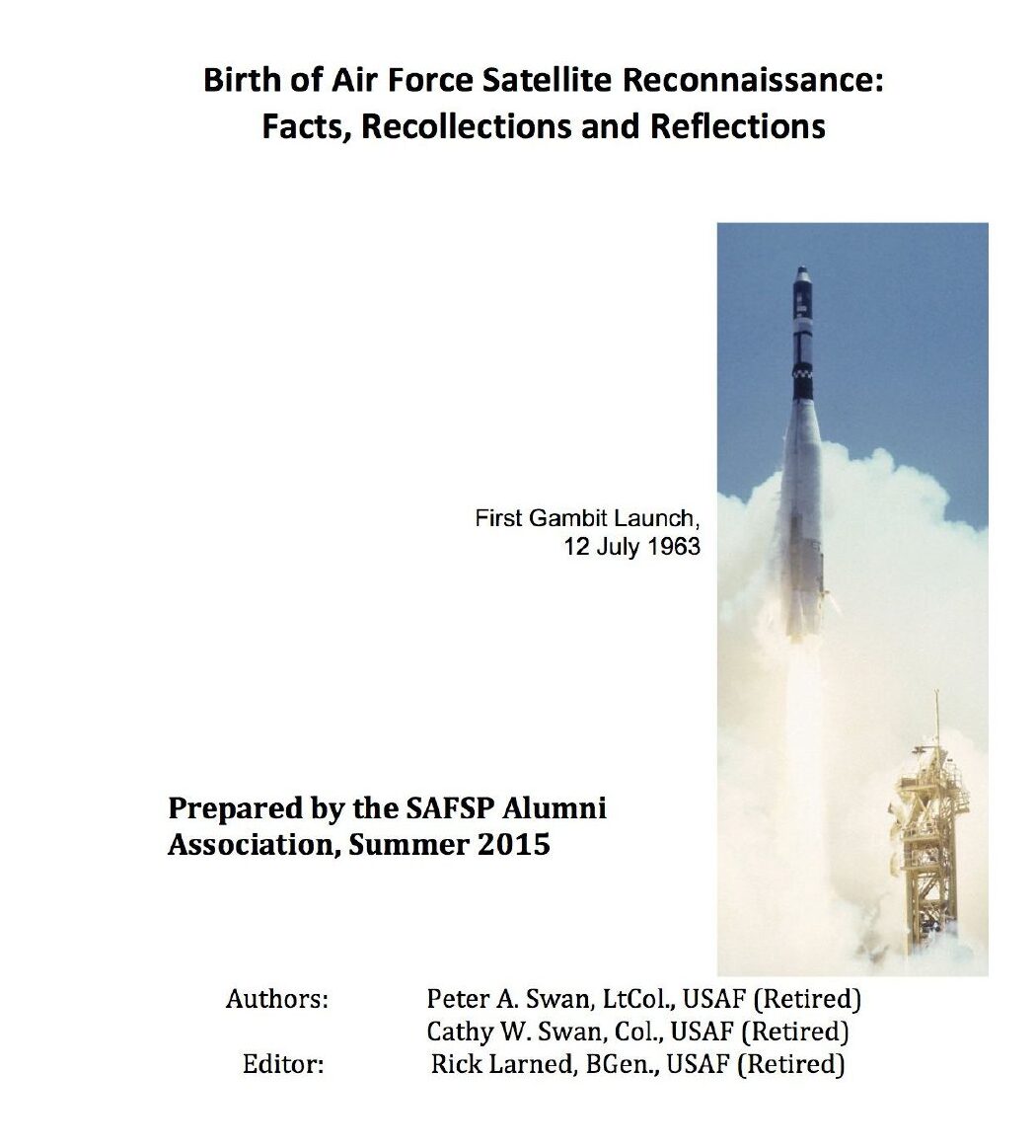
The National Museum of the Air Force in Dayton, OH has test models of the HEXAGON & GAMBIT satellite vehicles on public display. Gambit 1 and 3 are in storage at the Museum and we have requested that they be put on display for the Dedication event weekend. This affords a unique opportunity to witness history kept secret from the public for over 50 years. The CORONA vehicle is on display at the Smithsonian Air & Space Museum. Click HERE 2 min. (wait for YouTube to load)
Directors of SAFSP
1960-65 Major General Robert Evans Greer
1965-69 Major General John L. Martin, Jr.
1969-71 Brigadier General William G. King Jr.
1971-73 Major General Lew Allen Jr
1973-75 Major General David Bradburn
1975-83 Major General John E. Kulpa Jr.
1983-87 Major General Ralph H. Jacobson
1987-92 Major General Nathan J. Lindsay
1993-95 Brigadier General Donald R. Walker
1995-96 Brigadier General Thomas Scanlan
1996-98 Brigadier General Robert E. Larned
The Book
The definitive account of the history of the SAFSP organization from its creation in 1960, through its termination in 1998, can be found in “Birth of Air Force Satellite Reconnaissance: Facts, Recollections and Reflections.” (See below). Click Here to read all 157 pages online. To order it click here.